

Liquidation Tips · 14 min read
Amazon Pallet Liquidation Wholesale: Planning Multi-Pallet Orders
Plan Amazon-associated liquidation at wholesale scale with category specifications, evidence standards, landed-cost scenarios, and a structured quote journey.
Amazon pallet liquidation wholesale searches often come from buyers who need more than a one-off listing. At multi-pallet scale, category definition, grade tolerance, supplier evidence, freight planning, receiving capacity, and cash conversion matter more than promotional labels. Amazon is a trademark of its owner. PalletsSource is an independent wholesale storefront and is not affiliated with, endorsed by, or sponsored by Amazon. Amazon-associated source wording is used only where supplier evidence supports it; it does not promise direct access, identical loads, unit-level authenticity, or a guaranteed return. A structured quote journey helps Customer Care understand the merchandise and logistics you can actually handle before current availability is discussed.
📦 Define a buying specification before requesting volume
A useful request names preferred categories, acceptable grades, target pallet count, order frequency, destination, receiving equipment, and any hard exclusions. “Send the best Amazon pallets” is not a specification because “best” changes by sales channel. An electronics refurbisher may value testable returns. A discount clothing store may prefer broad size runs with manageable packaging wear. A market seller may want general merchandise with varied price points. A tool reseller may need battery platforms it already supports. Write the operational requirement first, then decide whether current listings or a wholesale quote can address it. Liquidation supply changes, so a quote can describe an available program without guaranteeing that future loads will be identical.
🧾 Set evidence rules for every source claim
At wholesale scale, small assumptions become expensive. Require source language to remain within supplier evidence. A manifest, invoice trail, program description, or other supplier record may support how a lot is described, while random branded cartons do not. If documentation does not identify Amazon-associated returns or overstock, the safer description is the broader category and condition. PalletsSource does not claim an Amazon partnership or guaranteed direct warehouse origin. Supplier evidence also has limits: it can support provenance language without certifying every unit’s brand authenticity, functionality, completeness, or retail value. Your receiving team still needs a category-specific inspection method.
📊 Information for a useful wholesale quote
| Input | Example detail | Why Customer Care needs it |
|---|---|---|
| Category | Tools, clothing, electronics, or general merchandise | Matches supply to processing capability |
| Condition | Customer Returns accepted; Used excluded | Defines grade tolerance |
| Quantity | Four pallets monthly or one ten-pallet order | Frames availability and consolidation |
| Destination | Postal code and commercial status | Supports freight review |
| Receiving | Dock, forklift, liftgate, appointment | Identifies delivery services |
| Timing | Flexible window or required date range | Prevents unsupported scheduling assumptions |
Wholesale pricing must be considered with transportation and processing. Consolidating pallets can improve freight efficiency, but only when the receiving location can unload and store them. Compare scenarios by total landed cost, not price per pallet alone. Include labor for breakdown, testing, cleaning, pairing, grading, photography, listing, and disposal. Include selling fees and a reserve for slow or unsellable items. Estimated retail figures and manifests can support planning, but neither guarantees realized revenue. Model several recovery outcomes and ensure the order remains manageable in a conservative case. PalletsSource does not promise margins, volume continuity, or a particular sell-through rate.
🛒 When listed inventory still makes sense
A wholesale buyer does not always need a custom program. Current listed pallets can be useful for category trials, staff training, testing a receiving workflow, or supplementing inventory. Use the cart when the displayed quantity fits and each listing has been reviewed. Use a quote when the order spans several pallets, requires recurring availability, or needs coordinated freight. A trial order should be sized as a real operational test, not as proof that every future pallet will perform the same way. Record time spent, sellable yield by your own standards, freight, and realized selling prices. That information produces a better second quote than relying on a generic target margin.
Provide category, condition tolerance, quantity, destination, and receiving details.
Start a wholesale pallet quote🚛 Design the receiving flow before the order ships
Multi-pallet deliveries require scheduled space, equipment, and staff. Confirm whether the carrier will deliver to a dock, whether liftgate service is needed, and how appointments are handled. Mark a staging area for unopened pallets and create a numbered receiving record for each load. Photograph wrap, labels, corners, and visible damage before breakdown. Note transit exceptions on the carrier paperwork. Keep exact-lot or representative photo rules in mind when comparing merchandise to the listing. Sort by category and condition, quarantine products that need safety or functional review, and retain the source and grade record. This process supports inventory control and gives Customer Care usable evidence if a material issue must be reviewed.
📈 Measure your operation without turning estimates into promises
Useful internal metrics include receiving hours per pallet, testing hours by category, sellable units under your standards, average days to list, realized revenue after fees, disposal cost, and freight per pallet. These are your business measurements, not seller guarantees. Compare several orders before drawing conclusions because liquidation composition varies. Do not publish supplier retail estimates as if they were verified current selling prices. Reprice individual items based on actual condition and market evidence. If source documents are absent for a claim, do not pass that claim to your own customers. A responsible wholesale chain preserves evidence and caveats from supplier to reseller.
Wholesale readiness checklist
- Written category and grade specification.
- Supplier-evidence standard for Amazon-associated sourcing.
- Conservative landed-cost and cash-flow scenarios.
- Confirmed freight services and receiving equipment.
- Space and labor for pallet-level documentation.
- Category-specific testing and safety process.
- Cart plan for listed trials or quote plan for volume.
- No dependence on fixed margin or continuity promises.
❓ FAQ
Is PalletsSource an Amazon wholesale partner?+
No. PalletsSource is independent and not affiliated with Amazon. Any Amazon-associated source description is limited to supplier-supported evidence.
Can wholesale buyers receive identical pallets every month?+
Liquidation inventory changes, so identical composition is not promised. A quote can review current category, grade, quantity, and timing options.
Is a manifest required for a bulk order?+
Not every lot has one. A manifest is provided only when supplied upstream and remains planning information rather than a unit-level guarantee.
What information should a bulk quote include?+
Include category, acceptable grades, quantity, frequency, destination postal code, commercial status, receiving equipment, and timing.
Does ordering more pallets guarantee a better margin?+
No. Freight efficiency may change, but condition, labor, demand, fees, and sell-through still determine results.
Can I test the category with a listed pallet first?+
Yes, when suitable inventory is available. Review the listing and use the cart for the displayed quantity, then measure the trial carefully.
Use a current pallet to evaluate category fit, grade tolerance, and receiving workflow.
Browse listings before scalingReady to buy · transactional
Shop this guide — order pallets now
On-site listings and checkout paths referenced in this article.
Same topic · informational partner guide
Inspect amazon wholesale liquidation on the floor at PalletsStockroom
Same topic — floor-inspection walkthrough. Wholesale pallets from the stockroom floor — inspect, quote, buy.
Inspect amazon wholesale liquidation on the floor at PalletsStockroomSame topic · informational partner guide
Shop amazon wholesale liquidation with confidence at PalletsBay
Same topic — trust-first buying guide. Clear lots. Clear price. Confidence to buy.
Shop amazon wholesale liquidation with confidence at PalletsBayBuy on PalletsStockroom + PalletsBay · commercial + transactional
Order wholesale pallets on partner storefronts
Checkout, bulk quotes, and the same-topic guide on each partner domain.
More from the blog
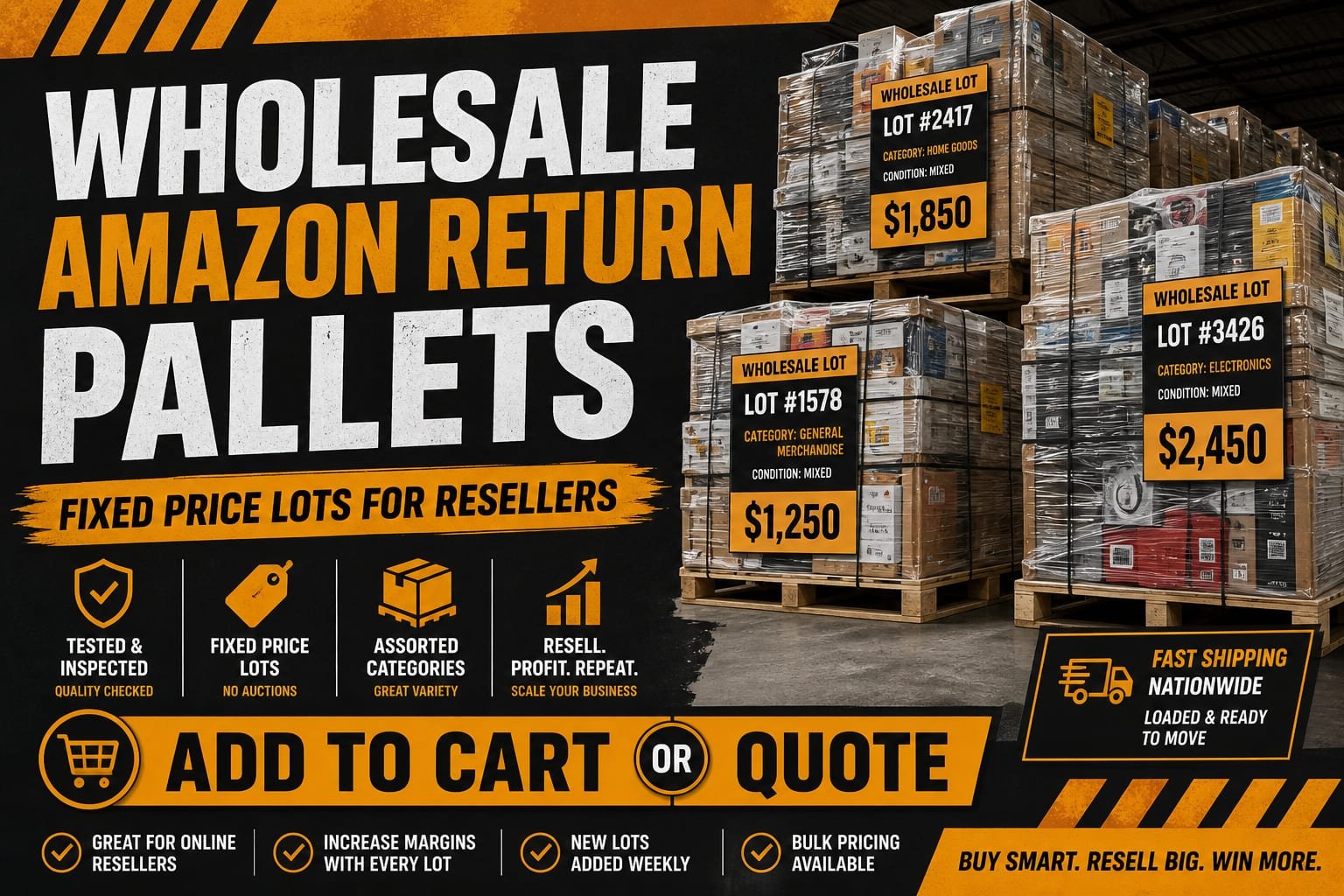
Wholesale Amazon Return Pallets Online: Reseller Pricing & CTAs
Wholesale Amazon return pallets online — commercial lots, fixed prices, and interlinked buy guides across the Amazon cluster.
11 min read
Buy Apparel Liquidation Pallets Online: Returns Clothing for Resale
Buy apparel liquidation pallets online with clear grades, checkout CTAs, and Customer Care — built for clothing resellers.
11 min read