
Buying Guides · 8 min read
How to buy pallets of Amazon returns without overcommitting
Buying more than one pallet changes the maths. How to choose categories, stage your orders, consolidate delivery, and scale up at a pace your storage and your sorting table can actually handle.
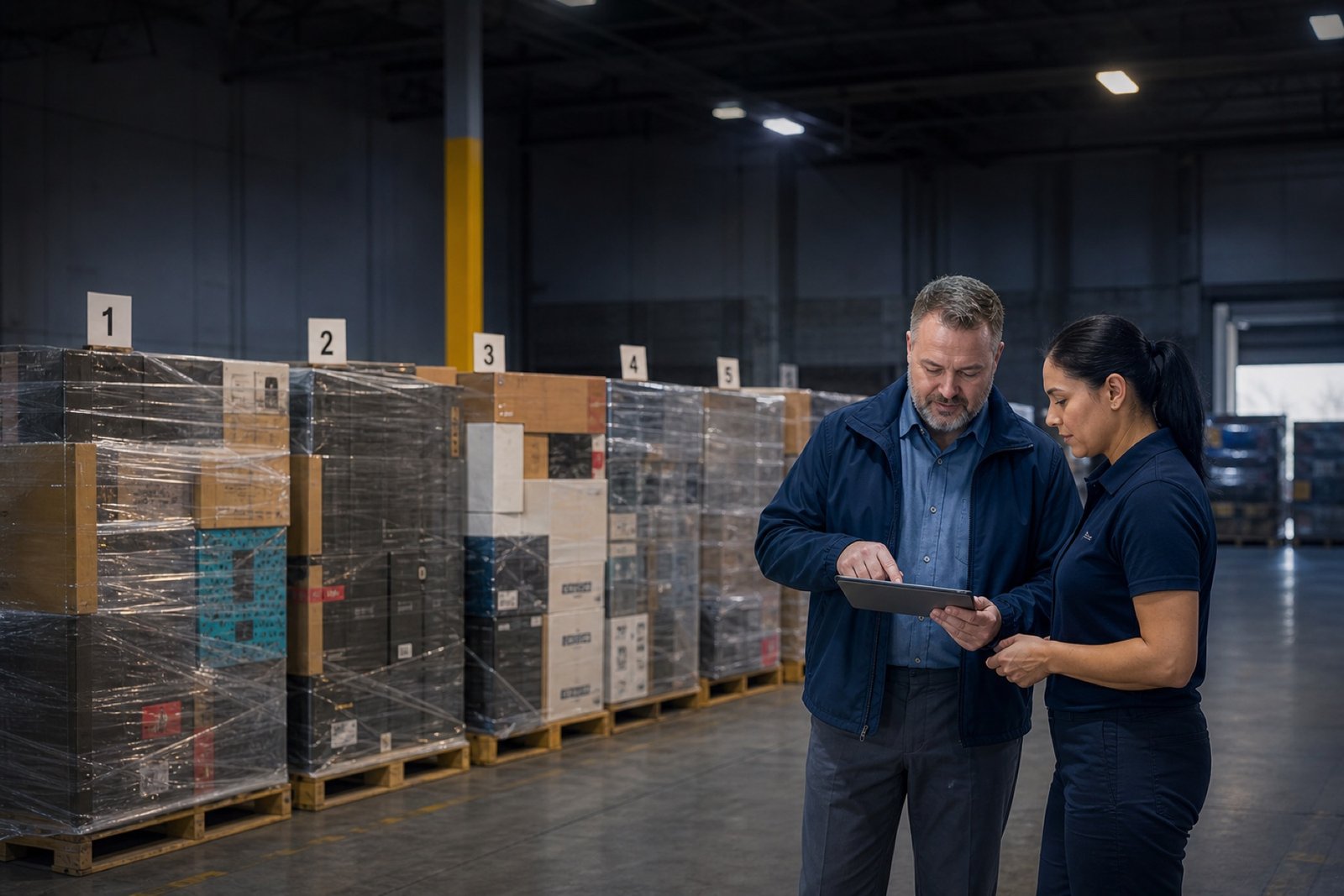
Buying one pallet is a purchase. Buying pallets, plural, is an operation. The moment you order more than a single load the constraints change: storage becomes real, sorting time compounds, delivery can often be consolidated, and the cost of choosing the wrong category multiplies rather than adds. This guide is about that shift. It assumes you have either bought once already or you have a clear reason to start with several, and it walks through choosing the mix, staging the orders, and keeping your first month from turning into a garage full of merchandise you have not touched.
📦 Decide the mix before you decide the count
The instinct when scaling is to buy more of whatever seemed cheapest. The better instinct is to buy the mix that matches the buyers you already have. A reseller with a clothing shop and a small tool following should buy against those two audiences, not against a spreadsheet of price per kilogram. Categories behave very differently on a sorting table: apparel is fast to grade and slow to photograph, tools are slow to test and fast to sell, and general merchandise is unpredictable in both directions.
Match categories to your sorting capacity
Every category has an hours-per-pallet cost that nobody puts on a listing because it depends entirely on you. Before ordering three pallets, work out honestly how many hours a week you can spend processing them. If the answer is six, three pallets of customer returns will take you longer to clear than the next order cycle, and you will be buying again before you have learned anything from the first purchase.
Start narrow, then widen
A common and effective pattern for a first multi-pallet order is two pallets in your strongest category and one in a category you want to test. You get depth where you already know your numbers and a controlled experiment alongside it. What you should avoid is three pallets in three unfamiliar categories, because when the results come in you will not know which variable caused what.
Storage is the constraint people forget
A standard pallet load takes more floor space than it looks like it will, and it needs space around it to work. Measure the area you actually have before you order, not after the delivery is booked.
Customer Care note
If you tell us the categories you are considering and the pallet count, we can tell you what is in stock and how the delivery is likely to be arranged. We will not tell you which mix will earn the most.
| Category | Typical handling effort | Storage footprint | Worth knowing |
|---|---|---|---|
| Clothing and apparel | Fast to grade, slow to photograph | Compresses well into boxes | Sizing spread drives your listing time |
| Shoes and sneakers | Moderate; pairing and boxing matter | Bulky per item | Mismatched pairs are a normal returns outcome |
| Tools | Slow; testing anything powered takes time | Heavy, needs solid shelving | Missing accessories are common in returns |
| Electronics | Slowest; every item needs testing | Moderate | Describe function honestly in your own listings |
| Toys | Fast, but completeness checks matter | Very bulky for the value | Seasonality affects how quickly it moves |
| General merchandise | Unpredictable by design | Mixed | The widest spread of outcomes on one pallet |
You can browse each of these as its own category page, which is usually a faster way to plan a mixed order than scrolling the full shop.
Mixed-category loads with the condition stated on every listing and the price fixed before you reach the cart.
Browse general merchandise pallets🧮 The maths that changes when you buy several
Three things move in your favour when you order multiple pallets, and two move against you. In your favour: delivery is often more efficient per pallet when loads travel together, your consumables go further, and your listing workflow gets faster with repetition. Against you: your write-off exposure is now spread across more merchandise, and any mistake in category choice is repeated rather than isolated. None of that is a reason to avoid scaling — it is a reason to scale in steps you can measure.
- Work out your realistic weekly processing hours and divide the pallets you are considering by that figure. That is your true clearing time.
- Price delivery for the whole order together rather than pallet by pallet, because consolidation is where multi-pallet buying usually saves money.
- Set a per-pallet write-off allowance from your own past results, and apply it to every pallet in the order rather than to the order as a whole.
- Decide in advance which pallet you will open first, and do not open the second until the first is fully processed and recorded.
- Record the outcome of each pallet separately, so a strong lot cannot disguise a weak one when you review the month.
- Only increase the count on your next order if the previous one cleared inside its planned window.
🚛 Consolidating delivery properly
Multi-pallet delivery is where a fixed-price shop with a Customer Care team earns its keep, because the arrangement can be planned rather than improvised. Tell us the pallet count and the destination, and be candid about access. Two pallets to a warehouse with a level loading bay is a straightforward job; two pallets to a residential address on a narrow street needs a tail-lift and a realistic conversation about what the driver can and cannot do at the kerb.
- Confirm the receiving window before the order ships, and make sure somebody will be there for all of it.
- Clear a staging area big enough for every pallet in the order, plus working space around them.
- Have straps, a knife, gloves and boxes ready before delivery day rather than sourcing them mid-unload.
- Photograph each pallet on arrival separately, and label the photographs with the pallet identity straight away.
- Never break down two pallets on the same table at once. The records get muddled and the numbers stop meaning anything.
Send the categories, the count and your postcode. You will get a straight quote rather than a call-back-for-pricing form.
Request pricing for a multi-pallet order🔁 A repeatable monthly rhythm
The buyers who make this work long term are boringly consistent. They order on a schedule, they process on a schedule, and they review the numbers on the same day each month. The rhythm matters more than any individual clever purchase, because it turns a series of gambles into a process with feedback. If a category underperforms twice in a row against your own recorded numbers, drop it. If one keeps clearing quickly, buy deeper into it next time.
- Week one: receive and process. Nothing new is ordered until the received stock is graded and listed.
- Week two: photograph, list and price. Keep the write-off pile separate and count it honestly.
- Week three: review the numbers per pallet, not per order, and write two lines of notes on each.
- Week four: plan the next order using those notes rather than using whatever looks cheapest that day.
⚖️ What we state, and what we will not
Amazon is a trademark of Amazon.com, Inc. Pallets Source is an independent liquidation retailer and is not affiliated with, endorsed by, or sponsored by Amazon. Lots described as Amazon returns are customer-return or surplus goods that passed through that retail channel before reaching the liquidation market, described with the sourcing detail our supplier provided and nothing beyond it. Manifests, item counts and authenticity or working-condition statements appear only when they were supplied for that specific lot. We do not guarantee pallet contents, and we make no representation about the profit any buyer will achieve.
❓ FAQ
How many pallets should a new reseller start with?+
One, processed completely, before ordering anything else. If you have already done that and cleared it inside your planned window, two or three is a sensible next step. The limit is almost never money — it is sorting hours and floor space.
Is delivery cheaper per pallet when I order several?+
Often, because pallets travelling together on one booking are usually more efficient to move than the same pallets shipped separately. The saving depends on the destination and the access, which is why we quote it rather than publish a single figure.
Should I buy several pallets in one category or spread them out?+
Depth in a category you already sell tends to beat variety you cannot evaluate. A common approach is most of the order in your proven category and one pallet as a controlled test of something new.
Can I mix categories in a single bulk order?+
Yes. Tell Customer Care the mix you want when you request the quote and we will price the whole thing together, including how it can be moved as one delivery.
Do multi-pallet orders come with manifests?+
Only where a manifest was supplied for a specific lot. Ordering more pallets does not change what the supplier gave us, and we will not generate documentation to make a larger order feel safer than it is.
What if I run out of space part-way through processing?+
Stop buying and finish processing. It sounds obvious, and it is the single most common failure point for resellers who scale quickly. Merchandise sitting unsorted in a garage is cost, not inventory.
Ready to buy · transactional
Shop this guide — order pallets now
On-site listings and checkout paths referenced in this article.
Same topic · informational partner guide
Inspect amazon return pallets for sale on the floor at PalletsStockroom
Same topic — floor-inspection walkthrough. Wholesale pallets from the stockroom floor — inspect, quote, buy.
Inspect amazon return pallets for sale on the floor at PalletsStockroomSame topic · informational partner guide
Shop amazon return pallets for sale with confidence at PalletsBay
Same topic — trust-first buying guide. Clear lots. Clear price. Confidence to buy.
Shop amazon return pallets for sale with confidence at PalletsBayBuy on PalletsStockroom + PalletsBay · commercial + transactional
Order wholesale pallets on partner storefronts
Checkout, bulk quotes, and the same-topic guide on each partner domain.
More from the blog
Amazon Returns Buying Guide Online: Care-Backed Reseller Playbook
Amazon returns buying guide for online buyers — grades, sorting labor, freight, and when to buy or ask Customer Care.
12 min read

How to Buy Pallets from Amazon Online: Clear Grades, Checkout CTAs
How to buy pallets from Amazon online — read the grade, review photos, checkout or ask Customer Care. Independent of Amazon.
12 min read