
Buying Guides · 8 min read
How to purchase Amazon returns: the full online buying journey
From the first search to the order confirmation email — how to read a condition line, budget the whole order, choose delivery, and buy Amazon return merchandise at a listed price instead of bidding for it.
Purchasing Amazon returns online should feel like any other considered purchase. You read the page, you understand what is being sold, you check what delivery costs, and you click buy when the numbers make sense to you. It should not feel like a gamble against a countdown clock, and it should not require you to phone a broker to find out the price. Pallets Source is built for the first experience: a listed price on the product page, a stated condition, a delivery choice you make yourself, and a Customer Care team you can email before you commit to anything. This guide walks the whole journey in order, so you know what happens at each step and what you should be checking along the way.
🛒 What you are actually buying
Merchandise described as Amazon returns is customer-return or surplus stock that moved through that retail channel before it reached the wholesale liquidation market. It is sold by the pallet, in the condition stated on the product page, and it is not a hand-picked retail shelf. Nobody, ourselves included, can tell you the exact item list inside an unmanifested lot. Any seller who promises a specific brand mix, a guaranteed unit count, or a profit figure is selling you a story rather than a pallet. What an honest listing can tell you is the condition class, the merchandise category, the approximate size of the load, and the price you will actually pay at checkout.
Condition is the field that decides everything
Before you look at anything else on a product page, read the condition. New, Open Box, Used, Customer Returns and Mixed each describe a different amount of work waiting for you when the wrap comes off. Customer Returns and Mixed lots routinely contain sealed items, opened items, incomplete items and cosmetically worn items on the same pallet, because that is how the returns channel works. That is not a defect in the listing — it is the product. If you want the least handling on your side, sort by condition first and category second, rather than the other way round.
Fields we leave blank on purpose
You will sometimes open a listing and find that a field simply is not there. That is deliberate. Manifests, piece counts, authenticity statements and tested-working claims appear only when our supplier supplied them for that specific lot. When they were not supplied, we leave the field out rather than estimating something that sounds reassuring. A blank field is information: it tells you to price the lot as unmanifested and to budget your own sorting time accordingly.
Photographs are part of the description
Treat the images as evidence, not decoration. Open them full size, look at whether you are seeing cartons or loose goods, and check whether the packaging looks retail-ready or already handled. Unless a listing states that the photographs show that exact lot, they are representative of the merchandise class and condition rather than a picture of the pallet that will arrive at your door.
Customer Care tip
If a page leaves you unsure about anything, message Customer Care before you order rather than after. We will tell you what we actually know about a lot, and we will happily tell you when the answer is that we do not know.
| Condition on the listing | What it usually means for the goods | What to plan for |
|---|---|---|
| New | Unused or sealed overstock and end-of-line stock | Lightest handling, highest price per pallet |
| Open Box | Packaging opened or replaced; product often unused | Repackaging time and honest box-wear descriptions |
| Customer Returns | Goods returned by shoppers for every possible reason | A full sorting pass and a realistic write-off allowance |
| Used | Previously used merchandise; function varies by item | Testing time and clear condition notes in your own listings |
| Mixed | Returns, overstock and end-of-life stock on one pallet | The widest spread of outcomes on a single load |
| Field left blank | The supplier did not provide that detail | Price it as unknown rather than assuming the best case |
Listed price, stated condition, no bidding and no buyer’s premium. Add it to your cart when the numbers work for you.
Browse customer return pallets🧾 The seven-step purchase journey
The steps below are the same for a first-time buyer and a returning one. Working through them in order keeps the decision calm, and it means the only surprise left is what is inside the cartons — which is the one surprise you cannot design away.
- Start from a category rather than a keyword. Pick the merchandise class you already have buyers for, then look at what is available inside it.
- Open two or three listings side by side and compare condition first, price second. A cheaper pallet in a harder condition class is not automatically the better buy.
- Read the description in full, including the sourcing note. If something is not stated, treat it as not supplied.
- Work out your delivery option before you add anything to the cart, because the movement cost changes what the merchandise is worth to you.
- Add to cart and check the totals page. The price you saw on the listing is the price of the pallet — no premium is bolted on at the end.
- Complete checkout and keep the confirmation email. It is your reference for every message you send us afterwards.
- Watch for the tracking or collection details, then prepare a clear space to receive and break down the load before it arrives.
💳 Budgeting the whole order, not just the pallet
The pallet price is one line in a short list. Buyers who last in resale keep the whole list in front of them before they commit, because a bargain that costs three hundred pounds to move and eleven hours to sort is not a bargain. The table below is a structure to copy, not a forecast: your channel, your labour rate and your location will produce completely different numbers, and we make no claim about what any lot will return.
| Line | Where the figure comes from | Notes |
|---|---|---|
| Pallet price | The listed price shown on the product page | Fixed at checkout, no auction premium |
| Delivery or collection | Freight quoted to your postcode, or fuel and time | Liftgate and residential access apply when they apply |
| Your sorting hours | Estimated hours multiplied by your own hourly figure | Returns take longer to process than overstock |
| Consumables | Bags, tape, labels, replacement boxes | Small per item, noticeable per pallet |
| Selling fees | Whatever your marketplace or shop actually charges | Varies sharply between channels |
| Write-off allowance | The share you expect to scrap or part out | Set it from your own experience, not someone else’s video |
- Fill the worksheet before you buy, then fill it in again from real numbers once the pallet is processed.
- Keep one worksheet per pallet so a strong lot cannot quietly subsidise a weak one in your records.
- Never carry another reseller’s recovery percentages into your own sheet. Their channel and costs are not yours.
🚚 Delivery, collection and tracking
How the pallet reaches you is a decision you make, not one that gets made for you. Freight to your address suits buyers without a vehicle for a full load; collection suits buyers who are close enough and want to keep the movement cost at fuel and time. Whichever you choose, tell us the honest truth about the delivery point. A tight residential street with no forklift is a different job from a warehouse with a level loading bay, and describing it accurately up front is what stops a delivery day going wrong.
- No loading bay and no forklift means you need a tail-lift delivery. Say so before the order ships.
- Clear a landing space in advance. A wrapped pallet parked across a walkway becomes a hazard within the hour.
- Photograph the load on arrival, from all four sides, before anything is cut open.
- Keep the confirmation email and the tracking reference in the same place, so Customer Care can find your order instantly.
Send us the listing you are looking at and your delivery postcode, and we will tell you what we know about the lot and what movement will look like.
Ask Customer Care before you buy🧠 The mistakes first-time buyers make most
- Pricing a return pallet as though every item will sell at full retail. Build a write-off allowance in from the start.
- Buying a category you have never sold because the price per pallet looked low.
- Ignoring the delivery line until checkout, then discovering the movement cost changes the whole decision.
- Assuming photographs show the exact lot when the listing does not say so.
- Cutting open two pallets on the same table at once, which makes your cost per item a guess by the end of the day.
- Scaling to five pallets before a single one has been processed end to end.
⚖️ Independence, sourcing and what we will not claim
Amazon is a trademark of Amazon.com, Inc. Pallets Source is an independent liquidation retailer and is not affiliated with, endorsed by, or sponsored by Amazon, and we do not sell on Amazon’s behalf. Stock described as Amazon returns is customer-return or surplus inventory that passed through that retail channel before reaching the liquidation market, described using the sourcing information our supplier provided. We do not publish manifests, item counts, authenticity statements or tested-working claims unless they were supplied for that specific lot, and we never guarantee the contents of a pallet or any profit from reselling it.
Every listing shows its condition and its price. Nothing is hidden behind a bid, a registration wall, or a request-a-quote form.
Shop every available pallet❓ FAQ
Do I need a business account to purchase Amazon returns from you?+
No. Our checkout works the same way any online shop does, and single-pallet orders are welcome. If you are buying at volume or want freight priced across several pallets, use the bulk quote form instead and Customer Care will work the numbers with you.
Is the listed price really the final price for the pallet?+
Yes. The figure on the product page is what the pallet costs, with no buyer’s premium added at the end. Delivery is quoted separately because it depends on where the pallet is going and what access there is at the other end.
Will the pallet match the photographs exactly?+
Unless a listing specifically states that the images show that exact lot, photographs are representative of the merchandise class and condition. Return inventory varies from pallet to pallet by its nature, which is why the stated condition matters more than any single image.
Is a manifest included with the order?+
A manifest is shown on the listing when our supplier provided one. When it is absent we do not create a substitute, and we would rather you priced the lot as unmanifested than relied on a number we invented.
How much of a return pallet will I be able to sell?+
There is no honest universal figure, and we will not pretend otherwise. Recovery depends on the category, the condition class, your selling channel and how much time you put into each item. Build your own expectation from your first few pallets rather than from someone else’s headline numbers.
What happens if something goes wrong with my order?+
Contact Customer Care with your order reference and your arrival photographs. Our returns and refunds policy explains what is covered and what is not, and we would always rather hear about a problem early than find out weeks later.
Ready to buy · transactional
Shop this guide — order pallets now
On-site listings and checkout paths referenced in this article.
Same topic · informational partner guide
Inspect buy amazon returns on the floor at PalletsStockroom
Same topic — floor-inspection walkthrough. Wholesale pallets from the stockroom floor — inspect, quote, buy.
Inspect buy amazon returns on the floor at PalletsStockroomSame topic · informational partner guide
Shop buy amazon returns with confidence at PalletsBay
Same topic — trust-first buying guide. Clear lots. Clear price. Confidence to buy.
Shop buy amazon returns with confidence at PalletsBayBuy on PalletsStockroom + PalletsBay · commercial + transactional
Order wholesale pallets on partner storefronts
Checkout, bulk quotes, and the same-topic guide on each partner domain.
More from the blog
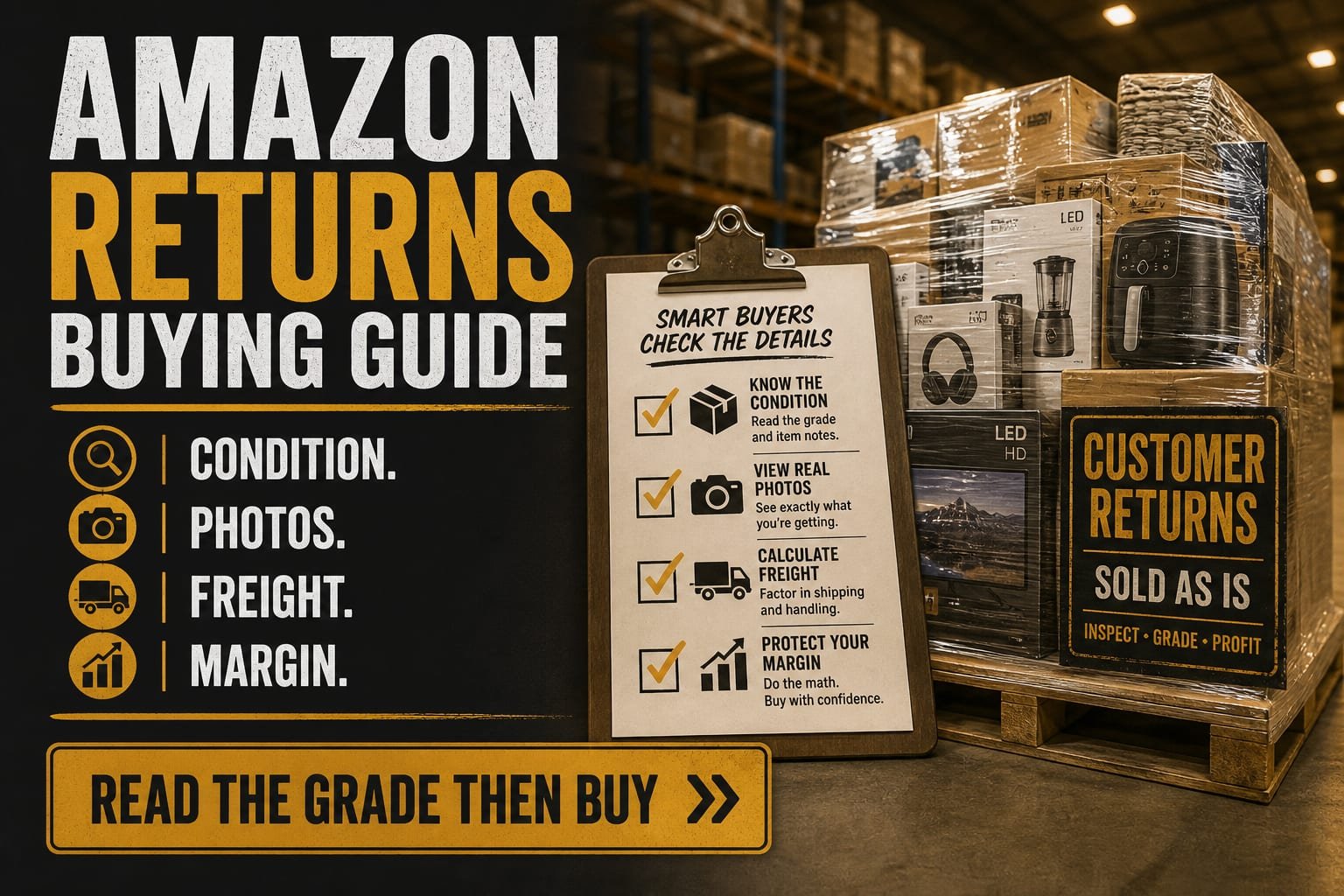
Amazon Returns Buying Guide Online: Care-Backed Reseller Playbook
Amazon returns buying guide for online buyers — grades, sorting labor, freight, and when to buy or ask Customer Care.
12 min read
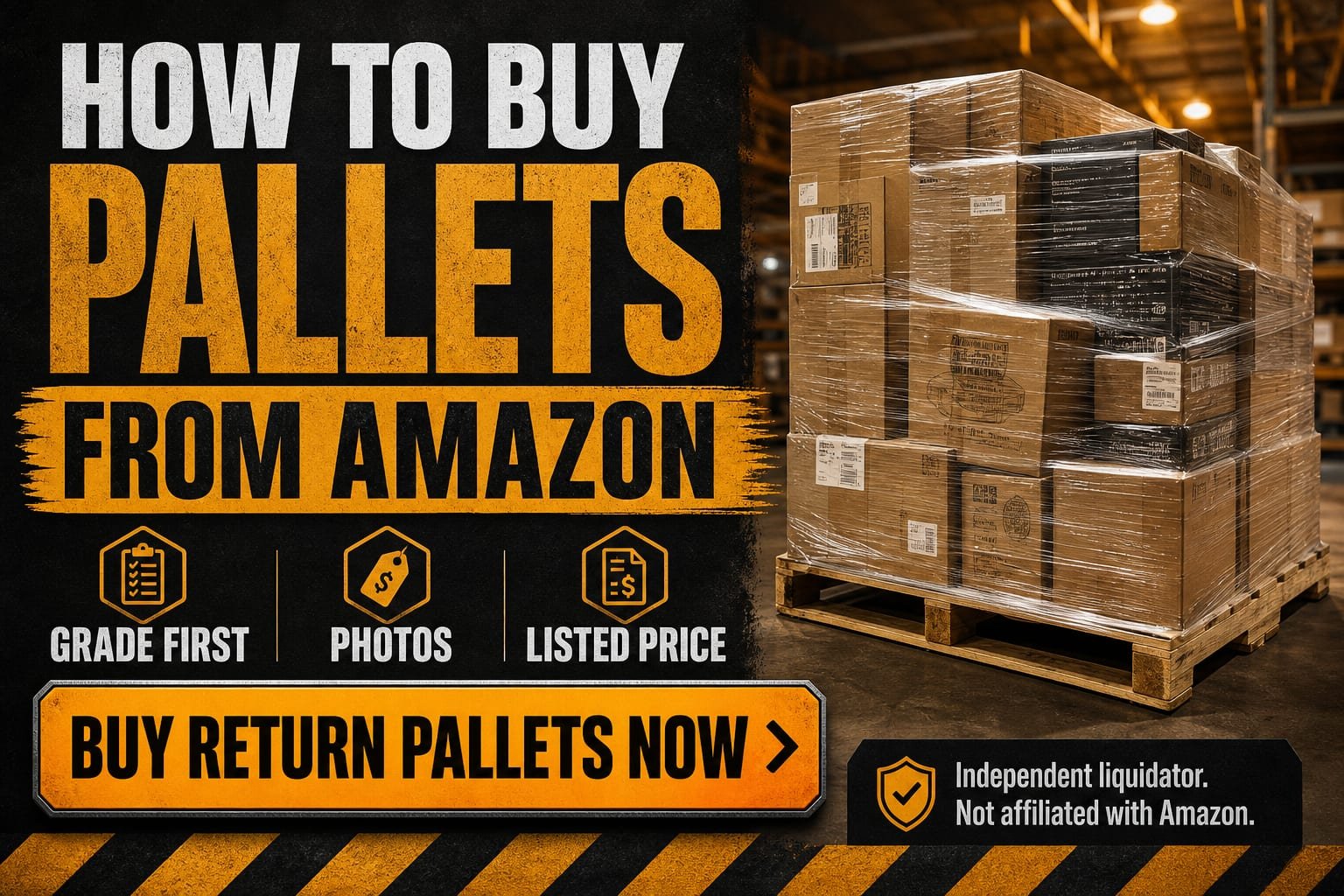
How to Buy Pallets from Amazon Online: Clear Grades, Checkout CTAs
How to buy pallets from Amazon online — read the grade, review photos, checkout or ask Customer Care. Independent of Amazon.
12 min read